🏷 This skill is productized at murderboards.ai for non-Claude Code-types. Read on if you just want the skill to use with your own agents.
Every’s Compound Engineering plugin does something cool during code review: it splits Claude Code into well-known, opinionated personalities like DHH and Kieran Klaassen who argue about your code. I love how easy they make this.
Forcing roleplay of well-known humans with their characteristic yucks and yums avoids the blandness of talking to a vanilla agent. Adopting particularly strong-willed humans’ values also avoids the annoying flip-flopping of a vanilla agent toggling between radically different opinions based on your latest prompt.
I wanted to be able to do this for anything (not just code/engineering), and I wanted even more debate between the personalities. So this weekend I built github.com/kamens/split-plugin, a Claude Code plugin that splits into multiple famous personalities to discuss anything you’re working on.
Ask it to /split on whatever you’re up to, and it’ll:
- Identify well-known, opinionated experts who’re relevant to your problem (e.g. Seth Godin and David Ogilvy if you’re working on marketing, Will Shortz and Merl Reagle if you’re generating puzzles, …)
- Spin up ~4-5 subagents, each adopting the personality and values of one of these experts
- Moderate a multi-round debate between the personalities
- Synthesize conclusions into advice for you
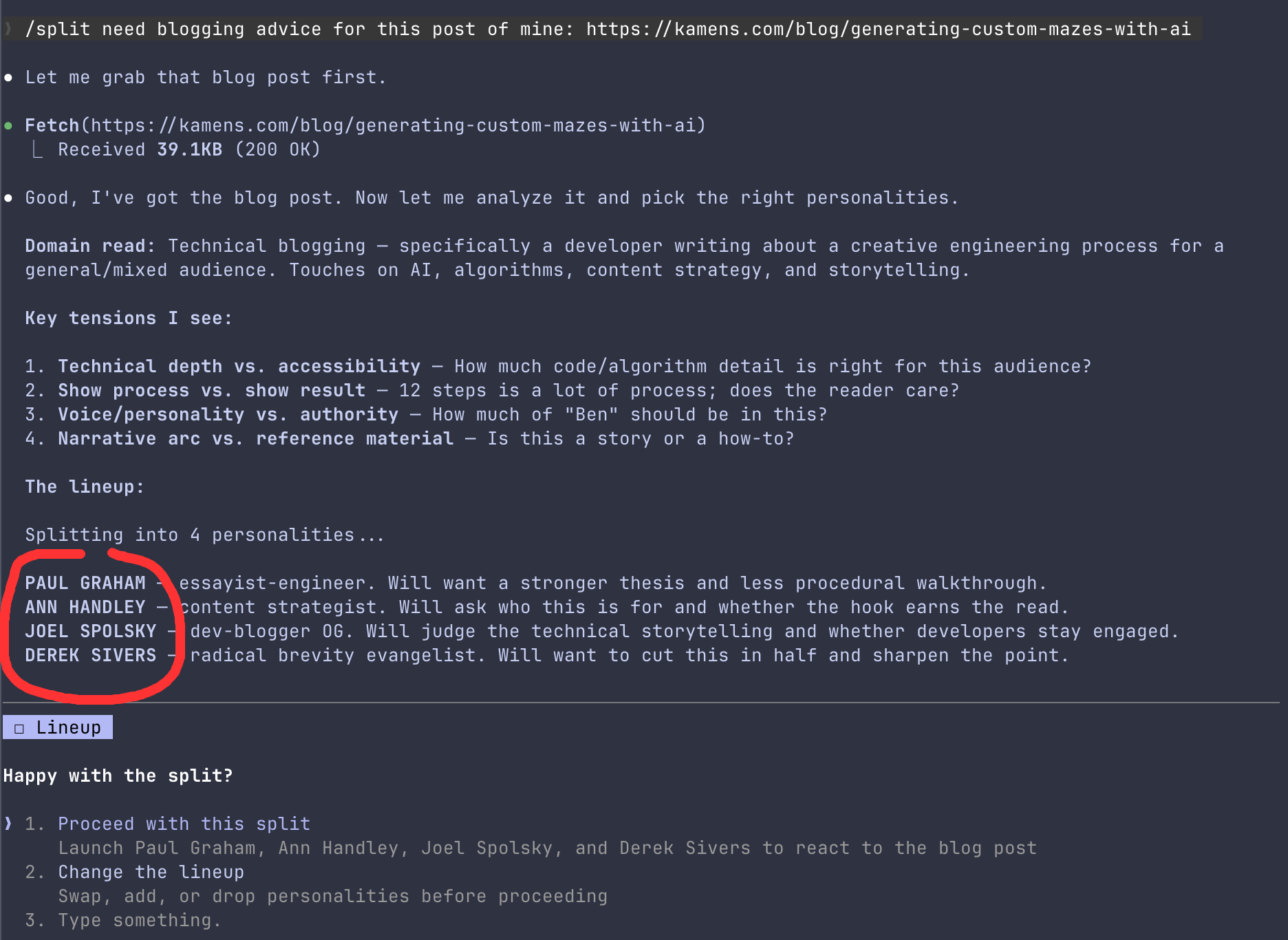
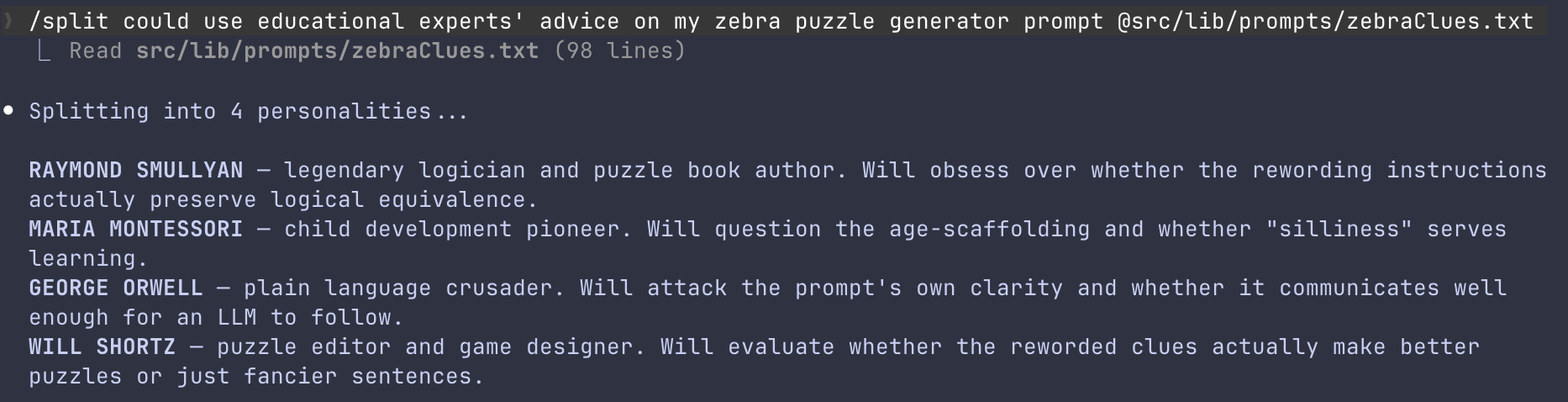
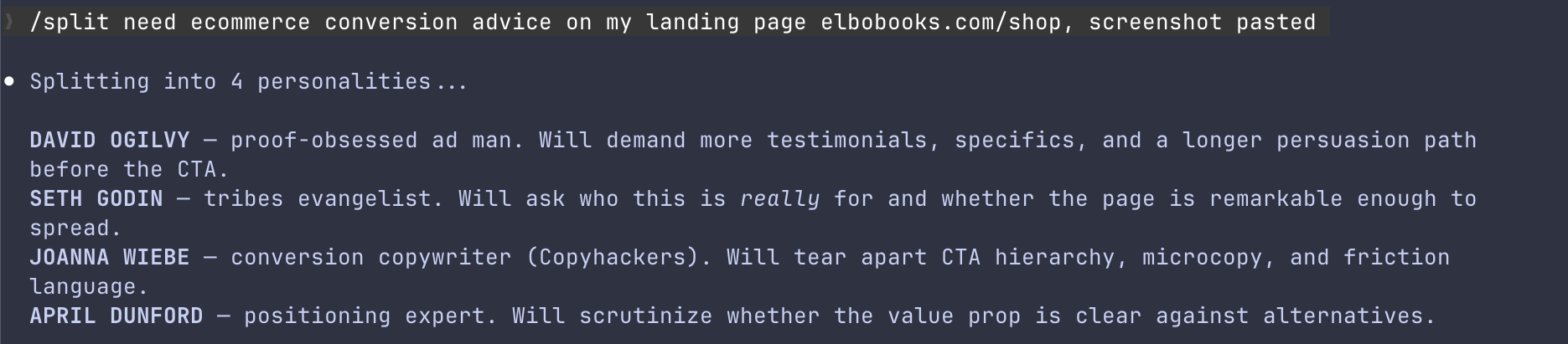
It feels magical when the Compound Engineering plugin splits off subagents with the personalities of DHH and Kieran, so my goal was to build a tool that let me copy this workflow for any type of work / any domain of experts. And I wanted even more debate. Key ingredients that make it feel magic:
- Well-known, opinionated personalities. You get far more interesting feedback by asking AI to become DHH (or Vonnegut or Hemingway) than to become ‘a generic Rails expert’ (or ‘an excellent, concise novelist’).
- 3, 4, even 5 of these personalities debating. I added a round of explicit back’n’forth discussion between subagents to better simulate debate (Compound Engineering relies on the main thread to synthesize disagreements after getting one round of feedback from subagents).
- Using subagents so each has their own context. This is nice for parallelization, but more importantly it lets the agents step into their personality more fully (vs using a single context, which gets cluttered up with the conflicting values of all interlocutors).
- All of this happening with a single slash command.
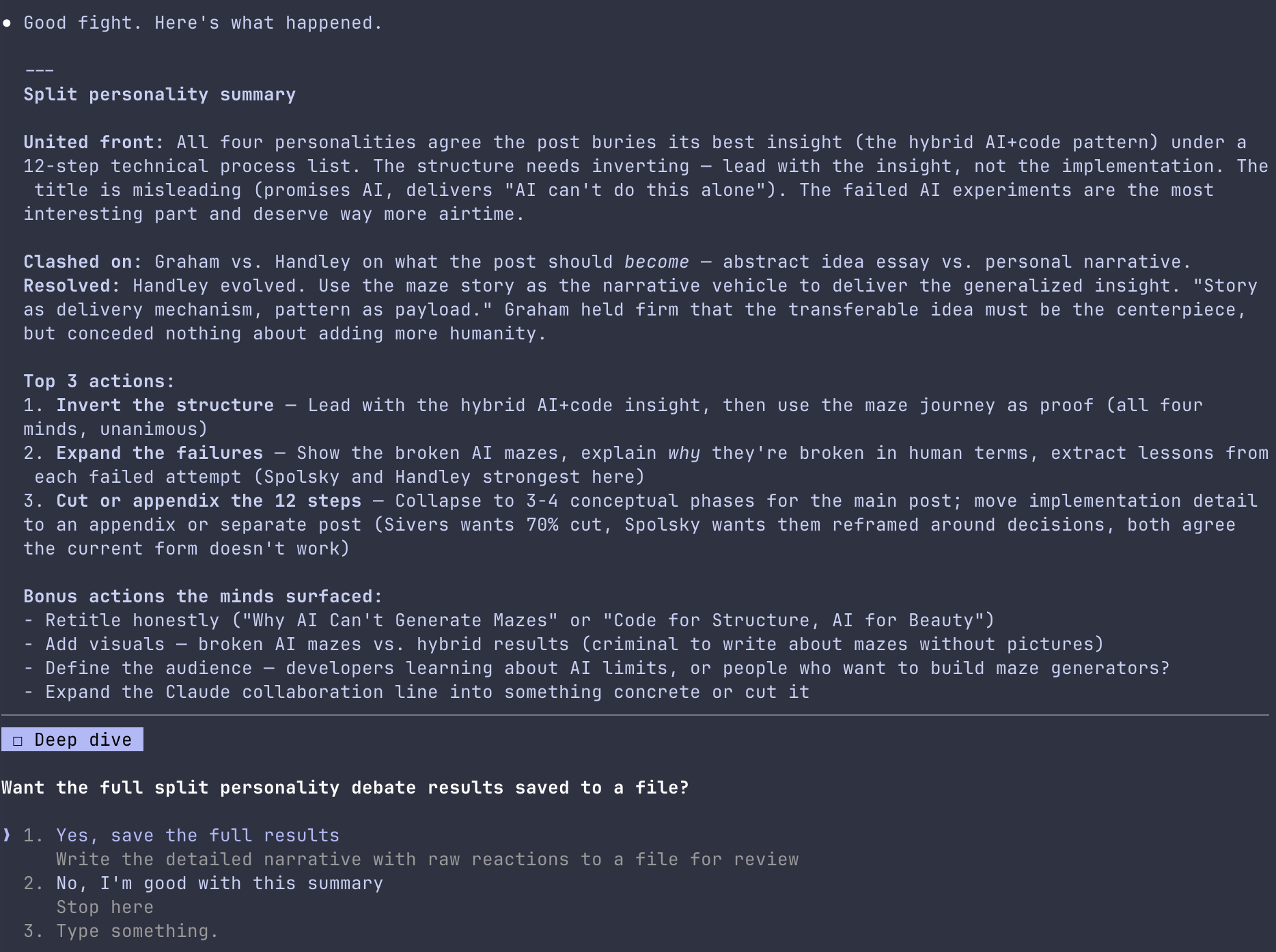
I like the results a lot. Much less (A) ‘reversion to the mean’ feeling and (B) milquetoast flip-flopper behavior. It gave me tips that dramatically improved this post you’re reading.
Try for yourself: github.com/kamens/split-plugin